Posts
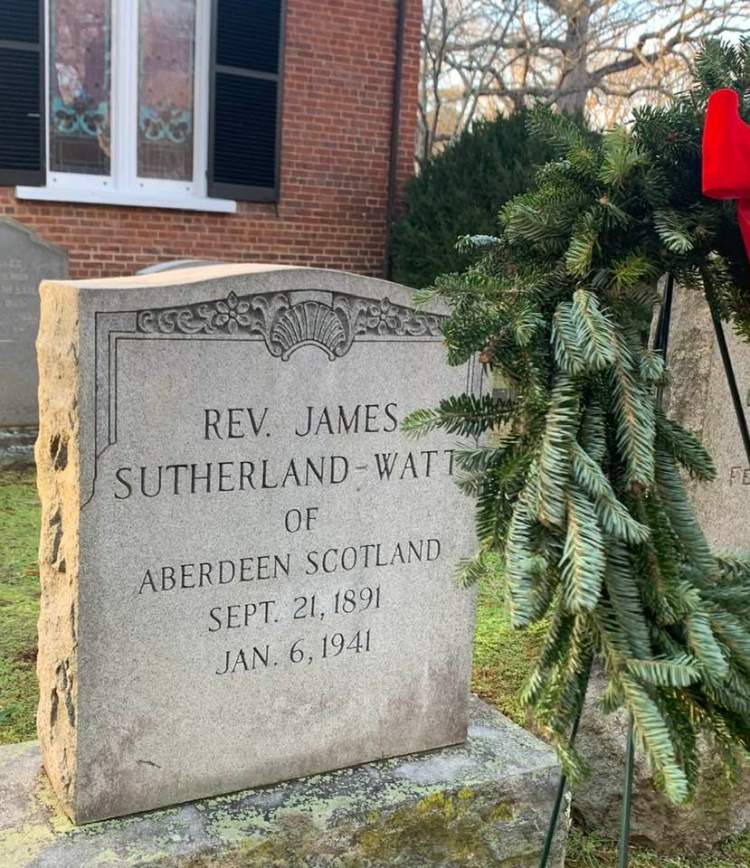
The Rev. James Sutherland-Watt
The Rev. James Sutherland-Watt, former rector of Christ Church and Grub Hill Episcopal Church, and his role in sparking the famous Western Front Christmas Truce of 1914
Rev. James “Jim” Sutherland-Watt (1891-1941) had a point-of-origin role in the renown, incredible Christmas Truce of 1914. At that time, Jim was an infantryman in the Scottish Gordon Highlanders Regiment. The Gordons, as they were called, fought in the Western Front trenches for four years during The Great War. Jim was born in Aberdeen, Scotland, on Sep. 21, 1981, a son of Sir Alexander and Isabelle Mortimer Sutherland. Jim returned to Aberdeen from Gibraltar on the Friday before the United Kingdom declared war against Germany. Jim’s newly-formed company of 200 soldiers was among the first 60,000 soldiers to land in France.
Here is his story as told to the Richmond Lions Club in 1937. Late on Christmas Eve 1914, after four months of intense fighting with many lives lost and many more wounded, Jim and his Battalion of the Gordon Highlanders Regiment, called “The Gordons,” occupied a sector of the terribly muddy trenches of the 70-mile long Western Front between Armentiers and Arras, when one of his trench mates suggested, “Jim, let’s sing Silent Night.” Jim had a fine singing voice and was often called to lead others in singing throughout his life. Jim responded, “I’m awfully sorry, but I have a headache.” Unabashed the soldier began singing anyway and Jim forget his headache and took up the strain. The other Gordons joined in. When they finished its last verse, they were amazed to hear cheering from the German Saxon soldiers occupying the trenches across No Man’s Land. Then from across the trenches opposite, the Saxons sang “Stille Nacht,” the German version of “Silent Night.”
All night long, the Saxons and the Gordons took turns singing Christmas carols to one another and cheering with appreciation. At dawn, came the order to “Stand to!” as suddenly from out of the mist, several gray clad figures approached from across No Man’s Land. The Saxons held their arms up revealing that they carried no guns. A few Gordons tried to go out to meet them but were ordered back into their trenches. Soon two German Saxon officers returned with a request for a twenty-four hour armistice. Word was went back to the Gordons’ headquarters and the temporary armistice was granted.
After officers agreed on the terms of the Christmas Day armistice, the Gordons and Saxons, both sides helping the other, set at once to collect and bury their dead, fallen soldiers who had been lying out in No Man’s Land, some for weeks. They dug two enormous graves side by side in No Man’s Land for approximately one hundred fallen soldiers.Then came the most awe-inspiring scenes of that or any war. With a Scottish chaplain presiding and a German theological student interpreting, a burial service was performed in both English and German. After the burial service, the enemy combatants went back to their trenches, but soon returned to No Man’s Land to offer gifts, barter goods, exchange souvenirs such as uniform buttons, and to socialize as best they could, despite their language differences. They went so far as to attempt to arrange a soccer (football) match, but it was never actually played in their sector. Scores of men did joyously kick a makeshift ball around. What began as a twenty-four armistice lasted ten days. On the tenth day, a bearded Saxon made his way over to the Gordons’ trench and warned, “The Saxons go! The Prussians are coming! Get in trenches and shoot like hell!”
When The Great War ceased combat on November 11, 1918, Jim, then an acting major, was recovering from his third wound in an Edinburgh hospital. He learned that of the original 200 soldiers in his company of Gordon Highlanders which landed in France in 1914, he was the only one left alive. Jim was decorated by King George V with a Good Conduct Medal and by France with the Mons Star with Rosette medal.
The Christmas Truce of 1914 was carried out in different ways all along the 70 mile long Western Front, but probably no was it welcomed so enthusiastically by both sides as in the sector occupied by the 2nd and 6th Gordon Highlanders and the Saxons opposite. In some places it was observed for Christmas Day only; In Jim’s sector, it did not end until its tenth day, when the Saxons were replaced by Prussians.
In 1919, Jim entered the United States. After working for a few years, he decided to become a minister. He was educated at Virginia Theological Seminary, graduating in the Class of 1924. While in Seminary, Jim was assigned to parishes in Halifax and Charlotte Counties. In 1924, Jim was ordained a deacon at Bruton Parish in Williamsburg by Bishop Beverly D. Tucker. Jim served as chaplain at the Virginia Theological Seminary before becoming the rector for Emmanuel Episcopal Church in Franklin from 1927 until 1935. Jim served as rector of St. Peter’s Episcopal Church in Norfolk from 1935 to 1938. In 1938, Rev. Sutherland-Watt was selected to serve as the rector of Manakin, St. Luke’s and Emanuel Episcopal Churches in Powhatan as well as Christ Church and Grubb Hill Episcopal Churches in Amelia.
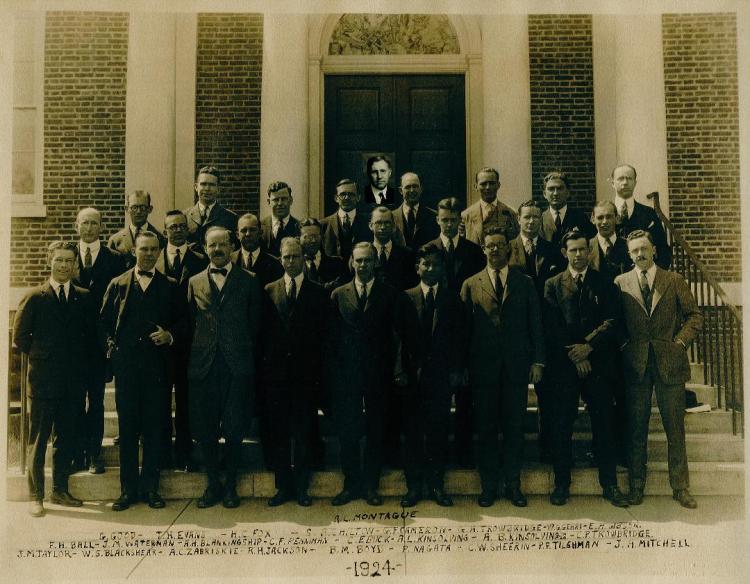
This writer sought to obtain photographs of James Sutherland-Watt from Cambridge University’s alumni archives, the Gordon Highlanders Museum in Aberdeen, the In Flanders Fields Museum in Ypres, Belgium, the Virginia Theological Seminary’s alumni archives, and from all of the churches where he served as a rector. Lt. Col. Michael Whitaker, Amelia, supplied the only image we have of Rev. Sutherland-Watt. Joshua Waits, archivist at the Virginia Theological Seminary in Alexandria, Virginia, supplied us with a picture of its Class of 1924. We believe that Jim is in the second row, on the far right. Ruth Cox, curator of the Gordon Highlanders Museum in Aberdeen, sent us a picture of some Gordon Highlanders and German Saxon soldiers taken together in No Man’s Land on Christmas Day. Jim might be among them; it’s impossible to tell.


 Christ Episcopal Church